Juice of Barley Country Dance Club
  • Home
  • About
  • Dance terms
  • Contact
  • Gender terms: Shold they be eliminated from the dance floor?
PLAYING FOR EARLY DANCES
The article below appeared in the December 2023 issue of EDS, the magazine of the English Folk Dance and Song Society. It is the copyright of the author and may not be reproduced without permission.

WHIMBLETON HOUSE
Picture

Between 1651 and 1728, John Playford and his successors published several editions of The Dancing Master, containing hundreds of dances, each with their own tune. Folk dance clubs who do not put Playford dances on the programme, are missing out. Many Playford dances are lively and interesting, and as suitable for today’s dancers as they were hundreds of years ago.

As a folk musician, if you have not been asked to play any Playford tunes at a club session before, there can be many challenges. My advice is that, even if you are a good sight reader, always look at the music in advance. A time signature of 3/2 or 6/4 is common and requires some thought if you have never met them before. Care should be taken to play the tunes in a way that reflects the dancers’ movements. 3/2 has three beats to the bar, but is not a ballroom waltz. 6/4 has two beats to the bar divided into groups of three, but is not a Scottish or Irish jig.

Some of the tunes, but not all, have the familiar format of 8 bars of A music, 8 bars of B music, but there can be any number of bars. The Whim, for example, has 6 bars for each section. Lady Williams’ Delight has 5 bars for the A music and 8 for the B music. Usually the A music and B music is repeated, but there are exceptions. If you have been given a modern score, it may be marked accordingly, but unfortunately, it is not always the case, so ask the caller in advance what repeats you should be doing.

The Mystery of Whimbleton House

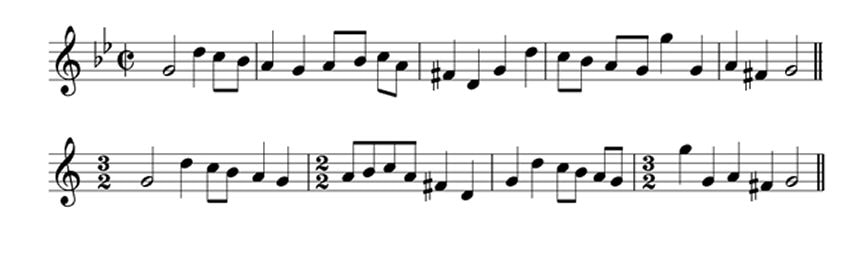
Getting the phrasing right, as in any dance music, is essential. For those who are not familiar with early music, one of the most confusing of Playford’s tunes is Whimbleton House. The original A music is shown to the left (top image)

The first thought is that the time signature is wrong. There are four segments, comprising three beats, two beats, two beats and three beats, or two five-beat phrases. A mistake surely? Some attempts to reconstruct the dance give the music an extra two beats, but this strips the soul out of this gem of a tune. Playford was a composer, not just a publisher. He knew what he was doing, so what is going on here?

To appreciate the tune, you need to set aside all you know about time signatures and bar lines. Early music did not have them. That’s right. No bar lines. The freedom this gave to composers produced some wonderful music. Without the regimented system of bars of equal length we have today, people like Giovanni Gabrieli, Thomas Dowland, William Byrd, Orlando Gibbons, to name a few, wrote fascinating and brilliant compositions. These days, the modern scores contain bar lines, but these are not necessarily an indication of where the phrases begin and end.

A system of bar lines and time signatures came into use about the middle of the 17th century, but it was not the rigid system we have now until later.  Whimbleton House was published in 1701, but we can assume the tune is much older than that. Faced with A music with 10 beats, and an expectation that the music will have bar lines, Playford solved the problem by dividing the bars into 2 beats. Anything else would have resulted in odd notes that did not belong to any bar.

Back in Playford’s time, they would have taken this in their stride. Musicians, used to having no bar lines at all, were not thrown by bar lines which fell in the middle of the phrase. They knew where the phrases began and ended and played accordingly.
For the modern musician, working out the correct phrasing in early music can be a challenge. It means looking at things from a different perspective, but it is rewarding when it ‘clicks’ and you realise what the composer was trying to say.

The bottom image on the left shows how the A music is written today. I hope you enjoy the tune as much as I do.

The Authentic Playford project

I love early music and I love dancing. What better than to put the two together and start constructing some of Playford’s dances from the original instructions? Many have not been done at all, while others have been, but are not true to the original instructions.
Dances can be difficult to work out. Playford used a kind of shorthand, brief notes that are open to interpretation. Sometimes, like early music, they need a different perspective. Language is used differently from today. What is the meaning of ‘go the figure’, for example? There is nothing more rewarding than when I have cracked the case, especially if it is a dance that has foxed others for decades, such as Whimbleton House. It was first reconstructed by Douglas and Helen Kennedy in 1929, but they did not follow the original instructions.

Having successfully reconstructed Whimbleton House, I was hooked. I went on to do other dances, and so the Authentic Playford project was born. It is still in its infancy, but new dances are being added all the time.

Some Playford dances are a little dull for today’s dancers and, without all the fancy footwork of the past, there is often too much music for the available steps. I address this problem in the project’s twin, Contemporary Playford. I write new versions of the dances that are more interesting for the modern dancer, while keeping as much of the original as possible. To distinguish between the two, only the original dance has the original name.


Creative Commons License
This work is licensed under a Creative Commons Attribution-NonCommercial 4.0 International Licence.
Powered by Create your own unique website with customizable templates.
  • Home
  • About
  • Dance terms
  • Contact
  • Gender terms: Shold they be eliminated from the dance floor?